
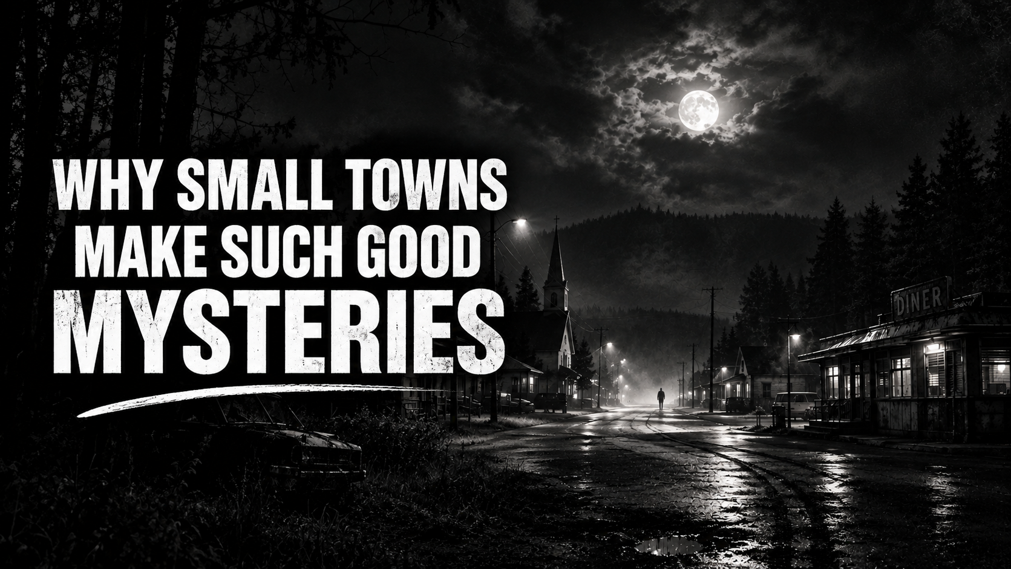
People sometimes think a small town is the last place where anything truly terrible could happen. You know the roads, the families, the church people, the children who grew up together. If somebody is sick, word gets around. If somebody’s boy gets in trouble, that gets around too. A stranger is noticed because there aren’t enough strangers for one to disappear into the crowd. That sounds like a kind of protection, and most of the time it probably is. But it also means people get used to trusting what is familiar. A person can stop being a stranger long before anybody really knows him. That is one of the things I find interesting about Sylville. The town is close enough that people feel they know one another, yet there are still things going on that almost nobody sees.
Kira grows up with that sense of familiarity. Sylville isn’t some frightening place she has been warned to avoid. It is home, and she knows Cotton Lake, the church, the long dirt roads and the empty fields. She knows where to go when she wants to get away from everybody for a while. She has a secret spot near the lake where she can write in her diary, and she thinks nothing of walking through the fields because they have always been part of her life. Even when there has already been a disappearance in town, life has a way of returning to normal. People search, people worry, people talk about it, and eventually children go back to school and families go back to supper. That doesn’t mean anyone has forgotten. It only means people still have to live.
That ordinary life is what makes danger in a small town so unsettling. If a person walked out of a dark alley in a strange city and told a child to follow him, the danger would be obvious. In Sylville, danger can look familiar, which is what happens during the confusion of the church fire when Kira follows a man because his story seems reasonable and because he doesn’t feel completely unknown to her. She has seen him before, and in a town where people know one another and where adults are always passing children back and forth between families, church, school and home, a familiar face can be enough. I don’t think Kira is foolish in that moment. She reacts the way a young person might react when everything around her is loud, confusing and moving too fast for her to stop and question every detail.
Small towns are also full of places that mean different things to different people. Cotton Lake is where Kira wants to fish and where she hides her diary. To Jamie, it is tied to the disappearance of his sister Jasper because the lake was searched after she vanished. The church is a place of worship, but it is also where Kira is restless and where adults talk, watch one another and make connections. The woods can be beautiful to somebody who has grown up around them, and they can also hide a cabin that nobody is supposed to find. None of those places has to change for the meaning of the place to change. The same road can feel harmless in daylight and wrong after something happens on it. People can change in the same way, at least in our understanding of them, and somebody can sit at your table one week and become the person everybody is looking for later.
I think that is one reason mysteries work so well in small places. There are fewer people, so every relationship matters a little more. The pastor knows the sheriff, families know where other families live, and a teenager may be the one who notices when somebody’s story doesn’t quite add up. Old friendships that seemed unimportant can suddenly matter very much. In Sylville, a passing comment about a fire becomes a clue because somebody stops and thinks about what Douglas Reardon could have known and when he could have known it. The clue isn’t some fancy piece of science. It is a question that comes from knowing the town and knowing the people in it. If Douglas had only arrived when he claimed he did, how did he know things he should not have known? In a big city, that detail might be lost among a thousand others. In Sylville, somebody remembers.
There is another side to that closeness. People can be slow to suspect someone they already have a reason to trust. Reverend Farley knows Douglas from years earlier. Douglas once studied for the ministry. He can be described as quiet, strange or private without immediately being treated as dangerous. The Floyd family allows him into their home because he comes through someone they trust. That is how community works when it is healthy: people introduce people, invite them to dinner and give newcomers a chance. I wouldn’t want to write a town where everybody is suspicious all the time, because then Sylville wouldn’t feel like a place worth caring about. The kindness has to be real or the betrayal of that kindness doesn’t matter.
The same is true of family life in the story. The Floyd house is noisy. Children argue, somebody is always trying to get out of a chore, meals are passed around, Mama worries and the boys get themselves into trouble. That normal family noise matters because a mystery isn’t interesting only because someone is missing. It is interesting because someone is missing from somewhere. There is an empty place where a person should be. Kira belongs in that house, at that table and in those arguments. When she disappears, the family doesn’t become a different family. They become the same family with one of their own gone, and that is worse.
In a small town, people also remember things that would probably be lost somewhere larger. They remember who was at church, who used to know whom, the girl who disappeared years earlier, and sometimes an old conversation comes back because it suddenly matters in a way it didn’t at the time. The town itself holds those things because the same people keep crossing one another’s paths. That can protect a community, but it can also leave people carrying secrets for a very long time.
Sylville isn’t frightening because it is a small town. Most of the time it is exactly the sort of place where people would want to believe their children are safe, and that belief is part of what lets the story work. It is easy to be careful when you already know you are in danger. The harder thing is finding out that the person you should have been afraid of was already around, and nobody knew enough to be afraid yet.